
 By Tsuky

Sharing a Spotify Family subscription with someone who lives elsewhere is becoming more difficult.
The music streaming service is asking some Premium Family members to scan a QR code displayed on their plan manager's phone.
Both people must be physically together, and the code changes every few seconds.
The procedure creates an obvious obstacle for people sharing subscriptions across different households.
It can also complicate matters for family members who are temporarily living apart.
On October 23, 2026, Ars Technica examined Spotify's increasingly strict enforcement of its sharing conditions.
Other publications had documented the verification method earlier in the week, while Spotify confirmed its broader approach during its third-quarter earnings discussion.
The most consequential part of the policy is not the QR code itself.
It is what happens if users cannot complete the verification within the permitted period.
How Spotify's QR code verification works
Spotify describes the process in its official support documentation.
When a member receives a verification request, the subscription manager must open the Spotify application on their phone.
They can access the code through their profile picture, the Your Premium section and the Manage option.
A QR code then appears on the manager's device.
The member who needs to verify their eligibility scans it using their own phone's camera.
Spotify says both people must be in the same location.
The procedure is supported through the mobile application.
The QR code changes every few seconds, making the reuse of a static screenshot less practical.
That does not demonstrate that every possible workaround is technically impossible.
It does show that Spotify is moving beyond a verification process based primarily on declaring the same home address.
Members have seven days after receiving a request
The seven-day deadline begins when a member receives a verification notification.
It does not mean that everyone must complete a new check every week.
Spotify's documentation indicates that selected Premium Family members may be asked to verify their residence.
The company has not announced an immediate check for every Family subscriber worldwide.
For people living together, the process may be relatively straightforward.
Both participants simply need their phones and a moment to complete the scan.
However, the deadline can become difficult for members who are traveling or staying somewhere else for an extended period.
A verification request might arrive when the member has no realistic opportunity to meet the plan manager within seven days.
That creates a practical problem even before questions about commercial eligibility are considered.
What happens if the verification fails?
Spotify's policy includes significant consequences for unsuccessful verification.
A member who fails to complete the process can lose access to the Premium Family subscription.
Their account may revert to Spotify Free.
The more substantial restriction concerns the following twelve months.
During that period, the member cannot join a different Premium Family or Premium Duo subscription.
There is an important qualification.
Spotify's official documentation allows the member to rejoin the same Family or Duo plan, subject to the applicable conditions.
The restriction is therefore not a universal ban on every shared subscription arrangement under all circumstances.
Nor is it a ban from Spotify Premium as a whole.
Users may still subscribe to an Individual plan.
However, losing the ability to join another shared subscription can significantly change the monthly cost for someone who relied on splitting a family subscription.
Losing Premium does not mean losing your Spotify account
An account returning to Spotify Free does not automatically disappear.
The change primarily affects subscription benefits.
Free accounts have different advertising and offline-listening restrictions.
Playlists and library information generally remain associated with the user's Spotify account.
However, downloaded music for offline playback depends on Premium functionality.
Those downloads should not be treated as permanently owned audio files.
Users can regain applicable Premium benefits by subscribing to an eligible plan.
Spotify has not described the QR code enforcement process as a system for deleting accounts or personal music libraries.
The same-household rule is not new
One of the most important details is that Spotify Premium Family was already restricted to people living at the same address.
That requirement predates the current reports by several years.
Spotify already used address declarations and occasional reverification procedures.
Members could be asked to confirm their address when joining a plan or after the manager changed their registered address.
The QR code adds another way to check that eligible members are physically together.
This difference matters because the plan's name can encourage misunderstandings.
Some people interpret Family as meaning relatives regardless of where they live.
Spotify defines eligibility through a shared household.
A sibling, adult child or parent living at another permanent address is not automatically eligible simply because of their family relationship.
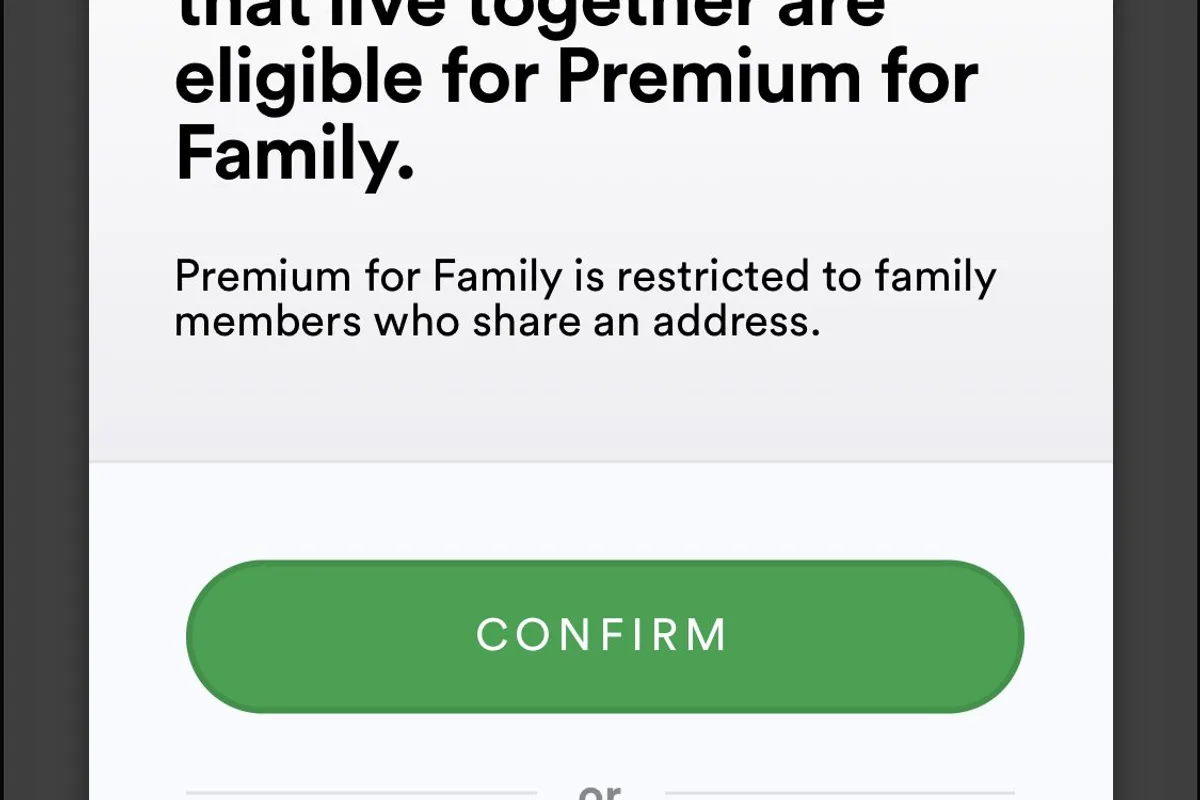
The historical illustration shows that Spotify's residence requirement existed long before the current QR code reports.
Real families do not always live together
The stricter verification method creates complications that go beyond friends attempting to reduce subscription costs.
A student may live away from home for much of the academic year.
A family member may travel regularly for work.
Partners may temporarily live in separate locations because of employment or other circumstances.
These arrangements do not eliminate family relationships, but they may create uncertainty about household-based eligibility.
Ars Technica highlights this difference between the ordinary meaning of family and the contractual meaning of a shared home.
The QR code also introduces a separate practical challenge.
Even a person who normally shares a household with the manager could be away when a verification request arrives.
Spotify's public documentation does not provide an exhaustive list of exceptions for all such circumstances.
Users who cannot complete a legitimate verification should consult official support rather than assuming an extension is guaranteed.
Does Spotify track users' locations?
The verification system also raises privacy questions.
How exactly does the service establish that both people are together?
Spotify says in its address verification documentation that it does not track members' locations and instead checks their address.
The QR code mechanism provides a form of proximity verification at the time of scanning.
However, publicly available documentation does not fully describe every technical record that may be generated during the process.
It does not provide a complete breakdown of associated metadata or retention periods.
There is therefore no basis for claiming that Spotify continuously tracks Family members through GPS.
Equally, it would be premature to state that the procedure generates no technical information whatsoever.
Digital verification normally involves processing events and determining whether a check succeeded.
That general observation does not establish Spotify's precise internal data collection practices.
The privacy question should remain separate from the commercial eligibility rules.
Why Spotify wants stricter enforcement
The economic motivation is relatively straightforward.
A Family subscription provides several Premium accounts for a combined price below the cost of equivalent individual subscriptions.
This offers strong value to households but also creates opportunities for people living separately to share the cost.
In an October 15 report, Goldman Sachs analysts suggested that a meaningful proportion of family subscriptions across music streaming services may be used by friends seeking lower prices.
They argued that tighter household verification could improve revenue per user.
That analysis does not prove that Goldman Sachs directly influenced Spotify's decision to use QR codes.
It does explain why streaming businesses have a financial incentive to apply eligibility requirements more strictly.
If people can no longer share a family subscription, some may purchase Individual plans instead.
That could increase the platform's total subscription revenue without changing the listed price of the Family plan.
However, Spotify has not publicly established how many conversions the QR code process has produced.
The financial impact remains a potential outcome rather than a measured result of the current rollout.
Spotify calls the changes routine verification improvements
During Spotify's third-quarter earnings discussion on October 22, co-CEO Alex Norström addressed the company's approach.
He characterized the changes as routine improvements to verification methods rather than a special crackdown.
Norström explained that Family subscriptions have been available for many years and represent a significant part of Spotify's subscriber base.
The company intends to improve verification methods continually as it identifies weaknesses.
That work has no stated end date.
This means the QR code system should not necessarily be viewed as a temporary campaign lasting only a few weeks.
Spotify has also not promised that it will be the final verification method.
However, the company has not published a detailed worldwide rollout schedule.
There is no confirmation that every Premium Family member in every country will immediately receive a request.
A familiar pattern from video streaming
Spotify's approach resembles account-sharing restrictions introduced by video streaming platforms.
Netflix strengthened its household rules after years in which sharing across different homes had been widespread.
Other video streaming providers subsequently introduced similar controls.
Music streaming has different usage patterns and economics, but the subscription question is familiar.
Platforms want to maximize paying subscribers while maintaining the appeal of multi-user plans.
The challenge is distinguishing eligible household use from account sharing designed to avoid individual subscription prices.
Strict verification can also surprise customers who did not fully understand the residence requirements when joining.
The definition of a household becomes just as important as the technology used to verify it.
What to do when Spotify requests verification
Users should first confirm that the request appears through Spotify's official application or established communication channels.
Unexpected messages asking for passwords or directing users to unfamiliar websites deserve caution.
The plan manager can access the QR code through their Premium subscription settings.
The affected member then scans the code using their own phone while both people are together.
If the process fails, Spotify recommends updating the application on both devices.
Users should also check the phones' date and time settings and try closing and reopening the app.
The code should be scanned directly because it changes every few seconds.
The seven-day deadline should not be overlooked.
Members facing genuine circumstances that prevent an in-person check can contact Spotify support to learn which options apply.
The public documentation does not guarantee that an extension will always be granted.
Family sharing increasingly means household sharing
Spotify has not introduced a completely new requirement that relatives live together.
It has strengthened the way an existing condition is verified.
Dynamic QR codes turn a declared address into a check requiring physical proximity at a particular moment.
For households whose members routinely live together, the change may have little impact.
For relatives and friends living separately, the consequences can be much greater.
The potential twelve-month restriction on joining another shared subscription also raises the financial stakes.
Spotify presents the process as ongoing improvement of its existing rules.
For users, the practical lesson is to understand exactly what their subscription allows before a verification request arrives.
The plan is called Premium Family, but eligibility remains based on a shared address. With the new verification process, that distinction is becoming considerably harder to ignore.