
 By Adri
A graphics card can remain listed by its manufacturer while becoming extremely difficult to find at retailers.
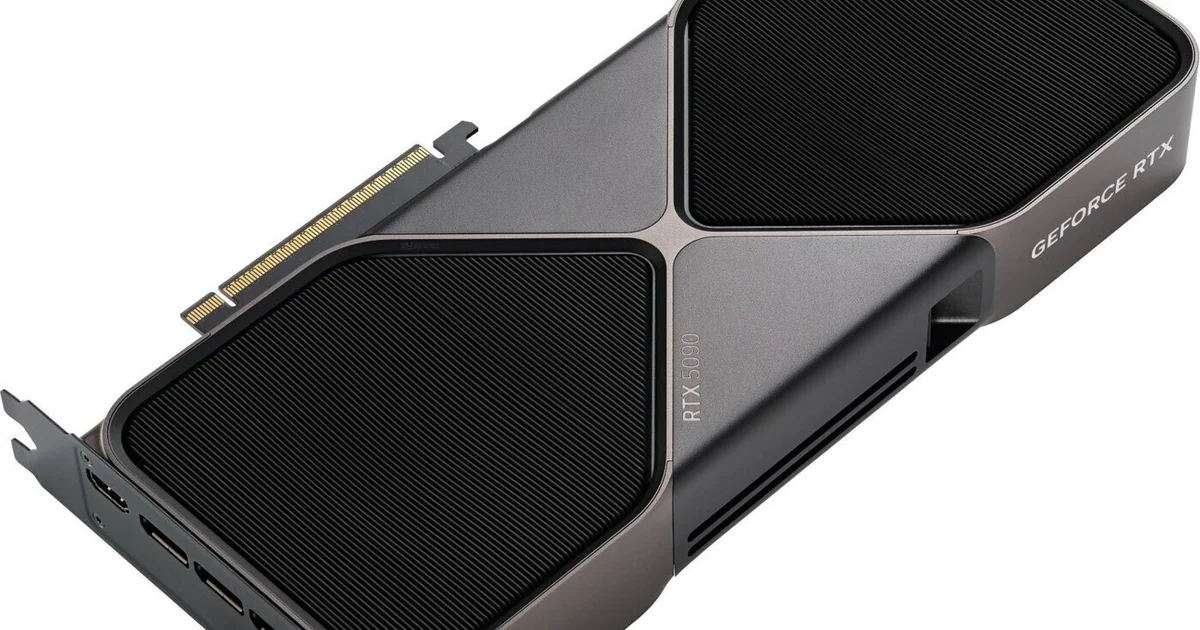
That difference between official product status and practical availability is central to the debate surrounding the GeForce RTX 5090.
Rumors that NVIDIA has stopped producing its most powerful consumer Blackwell graphics card have circulated for several weeks.
NVIDIA has denied those reports.
However, a new investigation by Roman Hartung, better known as der8auer, reveals unusual difficulties reported by companies within the card's supply chain.
On October 26, VideoCardz, Hardwareluxx and Notebookcheck detailed responses obtained from an NVIDIA board partner and a supplier of graphics card cooling systems.
Their statements do not prove that the RTX 5090 is discontinued.
They do raise questions about how many new cards may reach retailers over the coming months.
A board partner can no longer order GB202 and GDDR7 packages
The RTX 5090 uses NVIDIA's Blackwell GB202 graphics processor with 32GB of GDDR7 memory.
Board partners require those core components to manufacture their own card designs, combining them with circuit boards, power delivery systems and cooling hardware.
The unnamed manufacturer contacted by der8auer says it can no longer order packages containing the GPU and its memory.
More unusually, the company reports that it cannot place backorders.
During earlier supply shortages, the manufacturer had been able to request additional components and wait for availability.
The current problem would therefore involve the inability to order rather than simply longer delivery times.
The partner does not know whether NVIDIA will reopen ordering.
However, it also says it has received no official end-of-life notice for the RTX 5090.
That distinction is essential: a temporary ordering restriction does not necessarily mean that manufacturing has permanently ended.
NVIDIA insists the RTX 5090 is still active
Der8auer also contacted NVIDIA directly.
The written response he received was consistent with comments made earlier in October by Jeff Fisher, the company's head of Personal Computing.
NVIDIA acknowledges constraints affecting supply and production capacity.
However, the company maintains that the GeForce RTX 5090 has not been discontinued and will continue shipping.
The official position is therefore clear in one respect.
NVIDIA does not currently describe the graphics card as having reached the end of its commercial life.
The situation is less clear regarding volume.
The response provides no detailed schedule for future allocations or quantities assigned to individual board partners.
A product can therefore remain commercially active while receiving relatively limited production resources.
For buyers, that distinction may be more meaningful than whether a product continues to appear on a manufacturer's website.
Cooling-system orders are reportedly declining for 2027
A second source contacted by der8auer adds another dimension to the story.
It is a company supplying graphics card cooling equipment to manufacturers.
According to the supplier, two customers have substantially reduced their projected orders for RTX 5090 coolers for the first quarter of 2027 compared with the third quarter of 2026.
The company also reports receiving no orders for RTX 5090 cooling systems for the second quarter of 2027 at the time of the investigation.
This can be a meaningful signal in graphics card manufacturing.
Manufacturers often need to secure heatsinks, fans and mechanical components before final assembly.
Lower projections can therefore suggest reduced planned production.
However, these statements come from one supplier and its customers.
They do not represent a worldwide survey of all RTX 5090 manufacturing plans.
The absence of orders at a particular moment also does not rule out additional orders later.
The difference between discontinuation and shortage
Discussions about the RTX 5090 often combine several distinct industrial situations.
A product reaching end of life normally follows a commercial process in which manufacturers gradually stop accepting orders and producing new units.
A shortage describes a situation where demand exceeds available quantities or where supply capacity is constrained.
Between these cases, a supplier might reduce allocations without formally discontinuing a product.
It could also temporarily suspend new orders while reorganizing production.
The sources interviewed by der8auer do not establish exactly which situation explains every observed restriction.
NVIDIA's statement rules out an officially announced discontinuation for now.
The industry accounts nevertheless suggest that at least some partners lack normal access to essential components.
Both observations can be true at the same time.
Why 32GB of GDDR7 complicates supply
The RTX 5090 is one of the most component-intensive consumer graphics cards.
Its GB202 GPU contains 21,760 CUDA cores, according to NVIDIA's official specification sheet.
It is paired with 32GB of GDDR7 on a 512-bit bus, providing a quoted memory bandwidth of 1,792GB/s.
That memory capacity can benefit selected professional workloads, complex 3D scenes and applications using large datasets.
It also creates a manufacturing requirement.
Every card consumes a substantial quantity of high-speed graphics memory supplied through specialized industrial channels.
During periods of rising memory costs, manufacturers must make decisions about how those components are allocated.
Reduced GDDR7 availability can slow card assembly even when the GPU itself remains technically available.
However, the reviewed sources do not establish that the entire reported ordering restriction is caused by one specific memory shortage.
Is artificial intelligence influencing NVIDIA's priorities?
Several technology publications suggest another possible explanation: greater industrial priority for professional GPUs and AI-related hardware.
NVIDIA sells consumer GeForce cards alongside RTX PRO products and data-center accelerators.
Their commercial economics are different.
Certain components and manufacturing resources can be allocated across multiple product categories.
When supply is limited, those allocation decisions can influence consumer graphics card availability.
Wccftech suggests that the RTX 5090's difficulties may reflect resources being shifted toward professional GB202-based products.
That remains an interpretation rather than a confirmed company policy.
No official source reviewed establishes that NVIDIA has transferred all GeForce GB202 supply to RTX PRO products.
It would therefore be premature to claim that NVIDIA has definitively sacrificed the RTX 5090 for artificial intelligence.
Retail listings do not always reflect official product status
Retail availability provides another part of the picture.
VideoCardz and several American publications report that the RTX 5090 has disappeared from selected listings on NVIDIA's US Marketplace.
Micro Center has also been cited for listings indicating that the card is not carried through certain channels.
These observations reinforce concerns about limited supply.
However, they do not establish worldwide discontinuation.
A retailer may remove a listing, exhaust its allocation or change how it displays unavailable products without the manufacturer ending production.
A handful of listings from third-party sellers does not prove regular new manufacturing either.
Some available cards may come from inventory acquired earlier.
A reliable assessment of supply would require shipment volumes over time, rather than examining only a few online listings.
High asking prices do not prove production has ended
The RTX 5090 has also attracted attention because of exceptionally high retail asking prices.
Strong demand, limited supply and third-party resellers can create large gaps between launch pricing and available offers.
Some US publications have identified listings several thousand dollars above the original reference price.
Those examples illustrate difficult conditions in selected markets.
However, an extremely high listing price does not prove that a sale actually took place.
It also cannot establish the average price consumers are paying.
Buyers should distinguish asking price, verified availability, warranty conditions and seller reputation.
A scarce graphics card can attract speculative pricing without providing clear information about its future production schedule.
Board partners face a practical planning problem
The situation also matters for companies developing customized GeForce models.
Those manufacturers do not simply receive finished graphics cards.
They design circuit boards, cooling systems and operating configurations within NVIDIA's requirements.
Their business depends on relatively long production planning cycles.
They must reserve components, arrange assembly capacity and organize distribution.
If a manufacturer cannot order GPU and memory packages, planning additional production runs becomes difficult.
That uncertainty can also affect cooling suppliers and other subcontractors.
This explains why der8auer's reports matter even without establishing a general shutdown.
They describe supply restrictions upstream from the retail market.
Should buyers rush to purchase an RTX 5090?
The available evidence does not support a conclusion that every prospective buyer should act immediately.
NVIDIA maintains that shipments will continue.
The reported restrictions concern at least one board partner, with incomplete visibility into allocations to others.
No official date for ending RTX 5090 sales has been published.
Buying urgently because of an unconfirmed rumor could result in paying a price substantially above the product's normal value.
For gamers, the decision should depend primarily on performance requirements, display resolution and budget.
Professional workloads that genuinely benefit from 32GB of graphics memory may present different constraints.
Even in those cases, evaluating available alternatives is more reliable than assuming the card is about to disappear.
What to watch in the coming months
Several developments could clarify the situation.
The first is whether board partners regain the ability to order GB202 and GDDR7 packages.
The second is the volume of new cards actually delivered to retailers.
The third concerns future industrial orders for cooling systems and other parts required for assembly.
An official end-of-life notification would clearly change the product's commercial status.
For now, no such notice has been established by the reviewed sources.
NVIDIA's statements and the information coming from the industrial supply chain should therefore continue to be evaluated separately.
An officially active card with an uncertain supply outlook
The GeForce RTX 5090 has not officially disappeared from NVIDIA's product lineup.
The company denies discontinuation and promises continued shipments.
Meanwhile, der8auer's investigation describes one manufacturer unable to place orders and a cooling supplier observing declining industrial forecasts.
These accounts suggest a supply chain under pressure without proving that every production line has stopped.
Ultimately, the issue is larger than the administrative definition of end of life.
For a consumer, an officially supported graphics card offers limited value if it remains unavailable or carries an extreme price premium.
The decisive question may therefore be less whether NVIDIA announces the end of production and more how many new RTX 5090 cards actually continue reaching retailers.