
 By Adri
Fewer computers are being shipped, yet buying a new one is becoming more expensive. That contradiction captures the PC market's situation in late 2026.
Counterpoint Research's latest figures show a severe worldwide contraction during the third quarter.
Between July and September, manufacturers shipped approximately 57 million computers, down 21% from the same period in 2025.
Shipments also fell 13.8% compared with the previous quarter.
The original research was published on October 22 and subsequently covered by several technology publications during October 23–25.
The weakness extends beyond competition between individual manufacturers.
Lenovo, HP, Dell, Apple and ASUS all recorded annual shipment declines.
The important question is therefore not simply which brand gained market share. It is why customers are buying fewer PCs even though their computing needs have not disappeared.
Worldwide PC shipments fall to 57 million units
Counterpoint estimates that the worldwide PC market contracted by 21% year over year in Q3 2026.
The data are preliminary and may be revised as additional information becomes available.
The figures concern manufacturer shipments rather than necessarily measuring final sales to consumers.
That distinction matters.
A computer shipped to a retailer may remain in inventory before being purchased by an end user.
Conversely, a store can sell an older machine from existing inventory even as new shipments slow down.
Shipment estimates therefore describe the activity of manufacturers and distribution channels, not the exact number of customers who bought computers during the quarter.
Counterpoint nevertheless reports significant weakness in consumer demand.
Commercial demand has been relatively more resilient, supported by selected business replacement projects.
It has not been strong enough to offset the decline in consumer purchases.
Other research firms confirm a market-wide contraction
Counterpoint is not the only firm identifying a major downturn.
Gartner estimates worldwide Q3 2026 shipments at 55.4 million PCs, down 22.4% year over year.
Omdia reports 58.1 million units, representing a 21.2% decline.
The three firms do not publish identical totals.
They use different data sources, methodologies and sometimes different definitions of the PC market.
Their numbers should not be averaged to create a supposedly more accurate total.
However, their overall conclusions are consistent.
Each indicates that worldwide PC shipments dropped by roughly one-fifth compared with Q3 2025.
That agreement makes it unlikely that the apparent downturn results from an isolated measurement issue.
The decline is large enough to affect much of the computer supply chain.
DRAM prices are at the center of the crisis
The principal pressure identified by research firms concerns component costs.
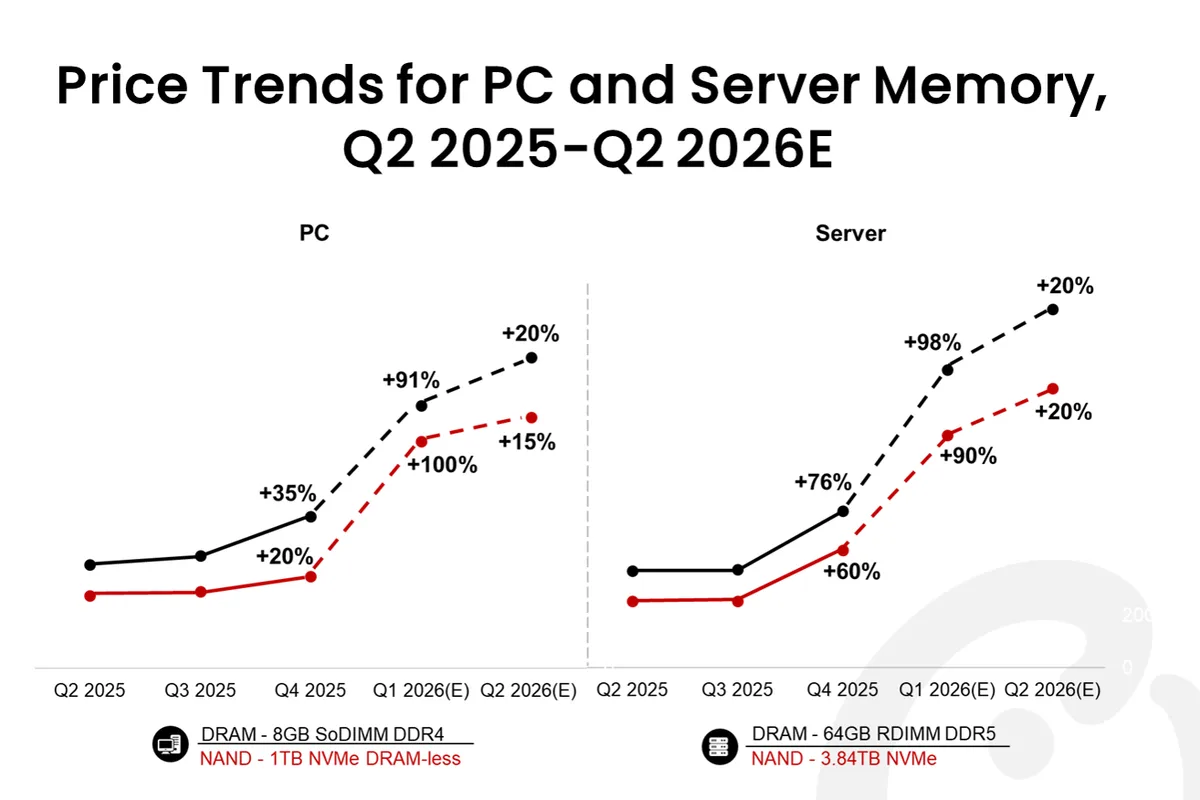
DRAM, used as system memory in computers, has experienced substantial price increases.
NAND storage components, including those used in SSDs, have also become more expensive.
According to Gartner, DRAM costs increased fivefold year over year during Q2 2026.
That figure describes component costs rather than the selling prices of complete computers.
Nevertheless, the effects on PC manufacturing can be substantial.
A computer contains a processor, motherboard, memory, storage, and, in laptops, a display and multiple additional components.
Manufacturers must purchase those parts before assembling their products.
When component costs increase sharply, companies have several choices.
They can absorb some of the increase through lower margins.
They can raise retail prices.
Or they can adjust configurations to reduce manufacturing costs.
In 2026, research firms have observed a combination of higher prices and product-line repositioning.
Memory and storage now account for much more of a PC's cost
Omdia provides another striking estimate.
The firm says DRAM and SSDs have increased from approximately 15% of a PC's cost to nearly 40%.
That changes how manufacturers calculate product profitability.
A premium computer may have more room to absorb an increase in memory costs within an already high selling price.
Entry-level machines generally operate with tighter margins.
An increase of even a few dozen dollars in manufacturing cost can have a much greater effect on their commercial viability.
Manufacturers may therefore prioritize higher-priced configurations that can better accommodate the additional expense.
That strategy can reduce the availability of affordable computers.
As retail prices climb, customers with limited budgets become more likely to postpone purchases.
The market enters a difficult cycle: components become more expensive, PC prices increase, demand weakens and shipment volumes decline.
Artificial intelligence is affecting the memory supply chain
The PC market's problems cannot be completely separated from broader changes in the semiconductor industry.
Artificial intelligence infrastructure requires enormous quantities of memory and storage.
Servers use conventional DRAM, specialized memory modules and high-capacity storage.
AI accelerators also depend on high-bandwidth memory.
These components are not all interchangeable.
However, their manufacturing ecosystems share certain production capabilities, investment priorities and supply-chain constraints.
TrendForce reports that memory manufacturers are increasingly prioritizing advanced production capacity for server applications.
That shift contributes to continued pressure on conventional memory supply.
For Q4 2026, TrendForce forecasts a further 10–15% quarterly increase in conventional DRAM contract prices.
It expects NAND Flash contract prices to rise 15–20% over the same period.
Those are forecasts for industry contract prices, not guaranteed retail increases for every RAM kit or SSD.
Lenovo remains the market leader despite a steep decline
The overall vendor ranking has not changed dramatically.
Lenovo remains the world's largest PC manufacturer according to Counterpoint.
The company shipped approximately 15 million computers during the third quarter, representing 26.3% of the market.
Its shipments nevertheless fell 23% year over year.
HP remained second with 10.3 million units and an 18.1% share.
Its 31% annual decline was the steepest among the major manufacturers highlighted by Counterpoint.
Dell ranked third.
The company shipped approximately 7.6 million PCs, accounting for 13.3% of the market and representing a 25% annual contraction.
These results show that exposure to business customers does not completely protect PC manufacturers.
Companies are continuing to replace selected aging computers, but the pace is insufficient to sustain overall shipments.
Apple gains market share while shipping fewer Macs
Apple presents an interesting case.
Counterpoint estimates Mac shipments at 5.6 million units during Q3 2026.
That represents an 11% year-over-year decline.
At the same time, Apple's market share increased from 8.7% to 9.8%.
The apparent contradiction is easy to explain.
A company can gain market share when its shipments decline more slowly than the overall market.
That is what happened here.
Counterpoint attributes part of Apple's relative resilience to the MacBook Neo.
The product helps the company reach buyers beyond its traditional premium laptop audience.
However, Apple is not experiencing shipment growth.
Its higher market share reflects stronger relative performance in a shrinking market.
Gartner also reports market-share gains for Apple, although its own shipment estimates differ.
ASUS records the smallest annual decline among the top five
ASUS is another manufacturer that has limited its losses relative to competitors.
Counterpoint estimates its shipments at 5.2 million PCs during the third quarter.
That represents a 7% annual decrease, smaller than those of the other top-five manufacturers.
ASUS shipments also rose 19.4% from the previous quarter.
Its market share increased from 7.8% to 9.2% year over year.
The company's broad portfolio may help explain some of that relative resilience.
ASUS sells consumer laptops, professional systems and gaming-focused products.
However, the reported figures do not demonstrate that every individual segment is growing.
They describe the manufacturer's overall shipment performance.
As with Apple, market-share growth should not be confused with annual growth in unit shipments.
Why consumers are delaying computer replacements
Higher prices are changing the calculation for many buyers.
Someone who owns a functioning computer may decide to keep it for another year.
The improvements offered by a newer model must justify a larger investment.
For everyday workloads, that decision can be reasonable.
Web browsing, messaging, office applications and media playback do not always require the latest processors.
However, a computer that still runs well should be distinguished from one that no longer receives essential security updates.
Keeping older hardware can save money, provided it continues running appropriately supported software.
Higher PC prices can also encourage buyers to consider repairs or upgrades instead of complete replacement.
But that strategy becomes less attractive when RAM and SSDs are themselves expensive.
Entry-level computers face the greatest pricing challenge
The cheapest computers are often the most sensitive to rising component costs.
Premium devices generally provide manufacturers with more room to spread additional expenses across the final selling price.
On an affordable PC, each component represents a substantial proportion of the total cost.
Reducing memory or storage capacity may help maintain a lower advertised price.
However, it can also reduce the computer's usefulness over time.
A system with limited RAM may struggle when several demanding applications run simultaneously.
A small SSD may force users to manage available space frequently.
A low initial price does not necessarily guarantee good long-term value.
Counterpoint identifies this as a central problem: manufacturers are prioritizing configurations better able to absorb component inflation.
That can leave price-sensitive consumers with fewer suitable choices.
Commercial demand remains more resilient but increasingly selective
Business demand has held up better than consumer demand.
Companies need to maintain their computer fleets, replace aging devices and support new workloads.
Software migration projects also influence purchasing decisions.
The end of standard Windows 10 support in October 2025 helped drive replacement purchases during the previous year.
Some demand was therefore brought forward.
Q3 2026 is being compared with an unusually strong prior-year period.
That elevated comparison base makes the annual decline more pronounced.
Gartner also notes that some businesses are concentrating spending on specific priorities, including workstations and AI PCs.
Those purchases are not sufficient to offset broader market weakness.
Commercial replacement cycles therefore provide less support than they did during the previous year.
Both desktops and laptops are affected
Omdia's figures provide additional insight into the structure of the downturn.
According to the firm, notebook shipments declined 20.6% year over year during Q3 2026.
Desktop shipments, including desktop workstations, fell 23.5%.
Omdia estimates 46.4 million notebook shipments and 11.7 million desktop shipments.
Both categories are therefore experiencing substantial pressure.
The decline cannot be explained solely by weakness in a particular market such as gaming or business computing.
It reflects broader difficulties in matching available products to customer budgets.
These figures belong to Omdia's methodology and should not be combined with Counterpoint's separate shipment totals.
The end of Windows 10 support also changed buying schedules
The comparison with 2025 includes another important factor.
Standard support for Windows 10 ended in October 2025.
That deadline encouraged some businesses and individuals to replace older computers.
Manufacturers and distributors also adjusted inventories amid tariff-related uncertainty.
Those developments supported shipments before the end of 2025.
The third quarter of 2026 is therefore affected by two influences.
Current component prices are discouraging purchases, while the comparison period benefited from orders brought forward.
That does not make the latest contraction insignificant.
It simply means the decline should not be attributed exclusively to higher memory prices.
Counterpoint forecasts another 27% decline in Q4
The outlook remains difficult.
Counterpoint expects worldwide PC shipments to fall 27% year over year in Q4 2026.
This is a forecast, not a result that has already been measured.
The final quarter is an important sales period, particularly because of year-end shopping.
Continuing component price pressure could limit manufacturers' ability to offer attractive promotions.
Omdia has a different projection, anticipating a 24% annual decline in Q4.
Both firms therefore expect another contraction, although not of identical magnitude.
Their forecasts diverge further for 2027.
Counterpoint expects annual volumes to remain broadly flat compared with 2026.
Omdia forecasts a further 7% decline for the full year.
These projections depend on component availability, demand and broader economic conditions.
Should buyers wait before purchasing a PC?
There is no universal answer.
If an existing computer still meets its owner's needs, waiting may avoid an expensive purchase.
That assumes the machine runs a supported operating system and provides enough performance for its intended applications.
When a computer has become inadequate, delaying replacement indefinitely may not be practical.
Current forecasts do not guarantee lower prices in the near future.
Buyers should therefore assess available configurations rather than relying exclusively on the hope that 2024 or 2025 pricing will return quickly.
Memory and storage capacity deserve particular attention.
A cheaper configuration with inadequate RAM or storage may create additional expense later.
For laptops with soldered memory, the initial configuration decision is especially important.
Repairability, spare-parts availability and software support duration also affect the usable life of a computer.
Those factors can matter more than small differences in benchmark performance.
The PC market is facing more than a temporary demand problem
The Q3 2026 figures point toward a broader change in the computer industry.
Rising memory and storage costs are affecting manufacturers' product strategies.
Affordable configurations are becoming more difficult to provide.
Consumers are keeping existing computers longer.
Businesses are concentrating spending on selected priorities.
Lenovo remains the market leader, while Apple and ASUS improve their relative shares.
However, all of the major manufacturers are reporting lower annual shipment volumes.
The forecast for another difficult quarter suggests that the pressure is unlikely to disappear immediately.
Even market stabilization in 2027 would not automatically constitute a recovery after such a substantial contraction.
For buyers, the practical consequence is already clear: choosing a computer increasingly requires balancing a constrained budget, more expensive components and the number of years the machine can realistically remain useful.