
 By Camille
Six years after launching the original HomePod mini, Apple has introduced its successor.
The new speaker retains the distinctive compact shape and its emphasis on music, voice control and smart-home integration.
Internally, however, the HomePod mini 2 brings a much newer processor, updated wireless connectivity and additional audio features.
It also arrives at a higher price.
The question for buyers is whether the capabilities available today justify that premium, particularly when Apple's next-generation Siri assistant remains a future feature.
A €169 smart speaker with a higher entry price
Apple is selling the HomePod mini 2 for €169 including VAT in Germany and Austria.
The official U.S. price is $149.
The original HomePod mini was introduced in 2020 and had previously been available for €109 in Germany before a price increase to €139 in summer 2026.
The second-generation model therefore costs €30 more than its immediate predecessor's final retail price.
Compared with the €109 price available earlier in 2026, the difference reaches €60.
That change matters because the HomePod mini has traditionally been Apple's comparatively accessible smart speaker.
A stereo pair now costs €338 at the German recommended price.
Four HomePod mini 2 speakers cost €676 before adding the compatible Apple TV required for Apple's newly announced surround configuration.
These figures illustrate how quickly the cost rises when a compact speaker becomes part of a larger audio system.
The S10 chip replaces the original S5
The HomePod mini 2 uses Apple's S10 processor, replacing the S5 in the first-generation model.
The original chip came from the Apple Watch Series 5 generation, while the S10 was introduced with the Apple Watch Series 10.
The newer processor supports Apple's computational-audio features.
According to the company, the speaker analyzes audio in real time to optimize dynamic range, loudness and acoustic performance.
Computational audio can help compensate for some limitations imposed by a compact enclosure.
A small speaker cannot move as much air as a significantly larger sound system.
Digital processing can nevertheless shape its frequency response and adjust playback according to the music and volume.
However, the presence of a newer chip does not establish a measurable improvement in sound quality by itself.
Apple has not published a complete independent comparison showing exactly how much better the new speaker sounds than its predecessor.
That will require direct listening tests and acoustic measurements.
Wi-Fi 6E and Bluetooth 6.0 modernize connectivity
The second-generation HomePod mini supports Wi-Fi 6E and Bluetooth 6.0.
The original model used Wi-Fi 4 and Bluetooth 5.0.
These updates bring the speaker's connectivity hardware closer to modern Apple devices and networking equipment.
However, newer wireless standards do not guarantee that every music listener will notice an immediate improvement.
Performance also depends on the home network, playback method and connected devices.
Bluetooth 6.0 should not be interpreted as proof that HomePod mini 2 works as a universal portable Bluetooth speaker.
The device remains closely integrated with Apple's audio and smart-home ecosystem.
Compatibility with the buyer's existing equipment matters more than the wireless version numbers alone.
Sound Glow adds music-reactive lighting
Apple introduces a visual feature called Sound Glow.
The illuminated surface on top of the speaker can pulse in response to music.
Lighting effects react to bass and treble, while colors can reflect the artwork of the song being played.
Apple also supports animations for certain soundscapes, including rain.
The feature is designed to create a visual atmosphere that accompanies audio playback.
It does not directly improve sound reproduction.
There is also a compatibility qualification.
Apple says voice control for Sound Glow requires an Apple Intelligence-enabled iPhone with current software.
Some advertised interaction features therefore depend on another compatible Apple device.
Five colors, with a familiar spherical design
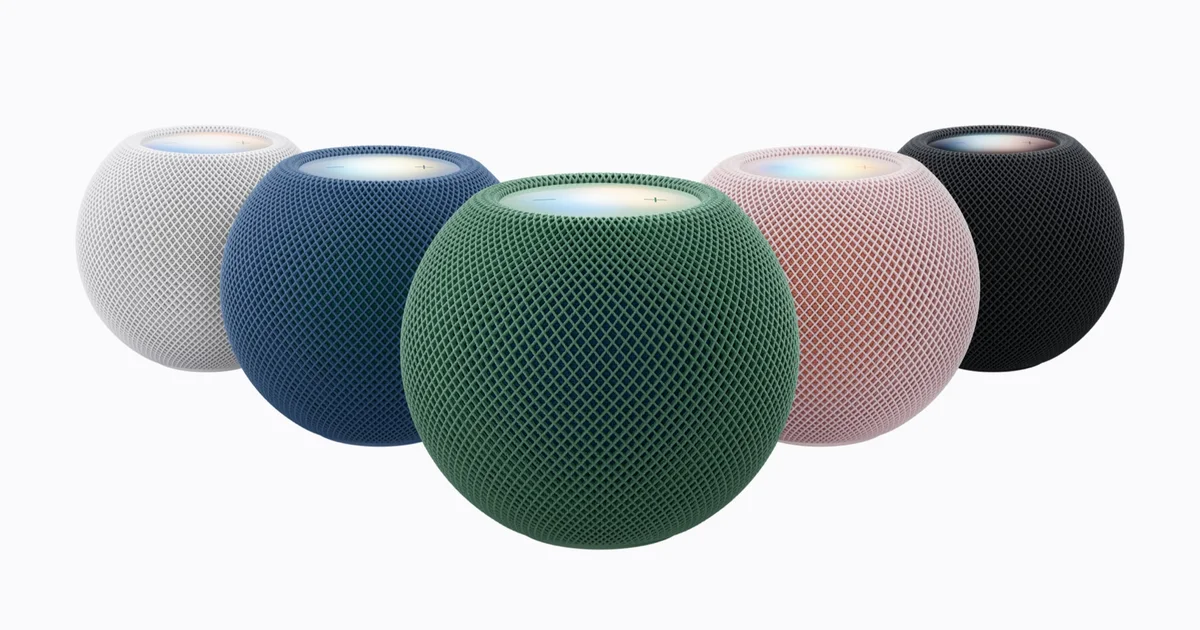
The HomePod mini 2 retains the compact spherical shape, fabric exterior and touch-sensitive top surface of its predecessor.
Apple offers five finishes: pink, green, blue, white and midnight.
The company also highlights matching color combinations with selected Mac computers.
The familiar design makes it easy to integrate the speaker into existing Apple setups.
However, most of the meaningful differences are internal rather than visual.
For owners of a functioning first-generation HomePod mini, the refreshed appearance alone may not justify replacing the device.
Four-speaker surround sound arrives with the new Apple TV
One of the more significant additions concerns home theater audio.
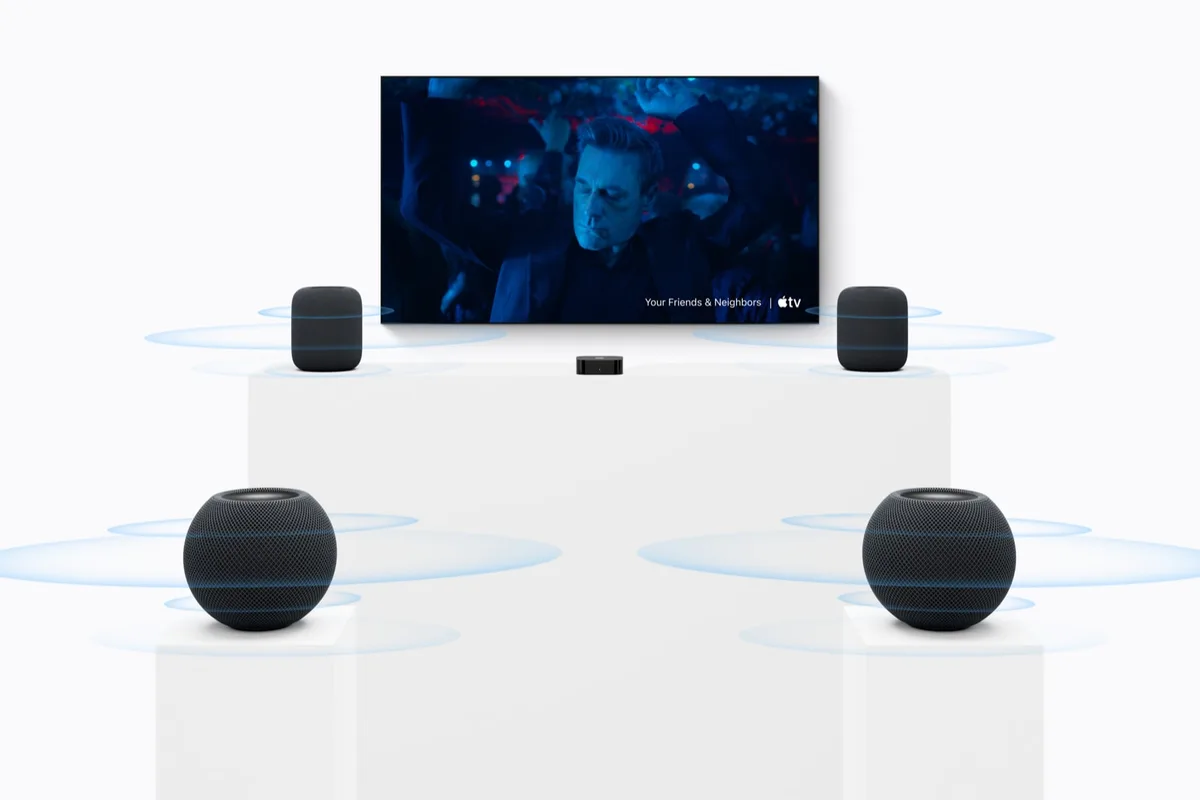
HomePod mini 2 can participate in a four-speaker surround configuration when paired with the fourth-generation Apple TV 4K.
Apple's arrangement uses two speakers at the front and two at the rear.
The system supports matching pairs of HomePod mini 2 or second-generation HomePod speakers.
Apple says the devices can recognize their positions and automatically adjust audio timing and levels to suit the room.
That could provide a more immersive listening experience than a single compact speaker.
Actual results will depend on speaker placement, room acoustics and the content being played.
The required Apple TV generation is an important limitation.
Owning an older Apple TV does not automatically provide access to the new four-speaker setup.
HomePod mini 2 can also become a Mac speaker
Apple is expanding the device's usefulness for Mac owners.
The new HomePod mini can serve as the default speaker for supported Mac computers.
Apple specifies that this requires a Mac with Wi-Fi 6E or later.
The feature works with a single speaker or a stereo pair.
Potential uses include music, films, games, FaceTime calls and video conversations.
For a desk setup, a pair of compact wireless speakers may offer a cleaner arrangement than larger conventional speakers.
However, audio requirements vary.
Competitive gaming, music production and other latency-sensitive activities can demand different performance characteristics.
Compatibility should therefore not be treated as a substitute for testing latency and synchronization in actual workflows.

Siri AI is not available at launch
The most important distinction in Apple's announcement concerns Siri AI.
Apple describes its future assistant as more conversational and capable of using personal context to complete complex tasks.
Examples include finding music mentioned in a message, creating contextual reminders and retrieving information across compatible applications.
However, these capabilities are not available on the HomePod mini 2 at its October 30 retail launch.
Apple says Siri AI will arrive through a future software update.
No specific release date has been announced.
Buyers should therefore distinguish the familiar Siri functions available today from the more advanced capabilities promised for later.
The device's hardware compatibility with Siri AI does not establish immediate software availability.
European users face additional restrictions
Apple's announced initial Siri AI rollout covers eight English-language markets.
They are the United States, Australia, Canada, India, New Zealand, Singapore, South Africa and the United Kingdom.
The European Union is not part of the initial list.
Apple also says Siri AI will not initially be available on iOS or iPadOS in the EU.
That limitation is important because some advanced HomePod functions require a compatible Apple Intelligence iPhone or iPad.
A buyer in Germany, France or another EU country should not assume that the new assistant will become available at the same time as in supported English-speaking markets.
Apple has not established a confirmed European release date for these functions.
The absence of a schedule should be treated as uncertainty, not as a guarantee of a later release on a particular date.
Some future AI functions require another Apple device
Apple outlines several compatibility requirements for Siri AI.
The owner of a household will need an Apple Intelligence-compatible iPhone or iPad with the relevant software and settings enabled.
Personal-context requests also depend on a paired compatible device.
Once the system is enabled, certain general conversational and knowledge features may benefit additional household users.
The distinction makes the product's future AI capabilities more conditional than a simple hardware feature.
Functionality will depend on device compatibility, language, regional availability and software updates.
Apple also notes that certain features relying on server-side models will have daily usage limits.
Expanded access may eventually be offered for a fee.
These statements describe future service conditions. They do not establish that customers must purchase an additional subscription for the HomePod mini 2's ordinary launch features.
Smart-home control remains a central function
The HomePod mini 2 continues to function as a home hub within Apple's smart-home ecosystem.
Users can control supported accessories through the Home app and create scenes or automations.
Depending on their equipment, they may use voice commands to control lighting, temperature and other connected devices.
Apple also promotes Sound Recognition for smoke and carbon monoxide alarm sounds.
When a supported alarm sound is recognized, the system can send a notification to the user's iPhone, iPad or Apple Watch.
Apple explicitly warns that the feature should not be relied upon in emergencies or other situations where personal safety is at risk.
It is an additional notification mechanism, not a substitute for certified safety equipment.
The feature also depends on the updated Home architecture and compatible software.
The strongest benefits depend on the Apple ecosystem
HomePod mini 2 is most compelling when integrated with other Apple devices.
Music playback, voice interaction, home automation and the new audio capabilities all benefit from that integration.
An owner of a recent iPhone, compatible Mac and current Apple TV may have access to more features than someone using predominantly non-Apple devices.
Not every feature requires every Apple product.
However, the more ambitious new capabilities have specific hardware and software requirements.
Four-speaker surround requires the appropriate Apple TV.
Mac default-speaker functionality requires a compatible Mac.
Siri AI depends on future updates, supported regions and eligible associated devices.
These dependencies should be considered when evaluating the real cost of upgrading.
Is upgrading from the first HomePod mini worthwhile?
The S10 chip and modern wireless hardware represent substantial internal changes compared with the six-year-old original.
New audio configurations may appeal to buyers building an Apple-centered home theater or desktop setup.
However, Apple's announcement does not provide independent evidence quantifying the improvement in everyday sound quality.
Users who primarily listen to music, set timers and control a small number of smart-home devices may not need to replace a functioning first-generation model immediately.
The promised Siri AI experience should be treated particularly cautiously in the European Union.
It is not available at launch and no confirmed EU rollout date has been provided.
At €169, the HomePod mini 2 needs to justify its price through features buyers can actually use today.
Sound quality, connection reliability, desktop audio and the new surround options will be more meaningful measures than future software promises.
Apple has modernized its compact speaker without abandoning its identity.
Whether that is enough to justify the higher price remains a question for real-world testing, particularly among buyers waiting for a fundamentally more capable voice assistant.