
 By Camille
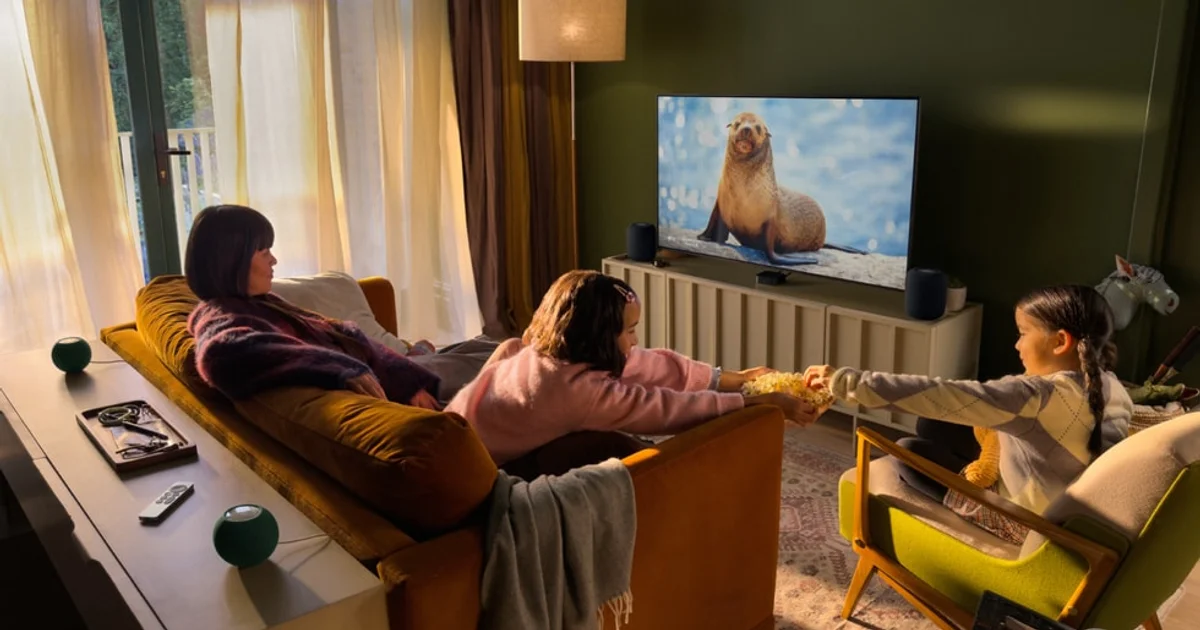
Apple has traditionally emphasized simplicity in its living-room audio products.
An Apple TV 4K combined with one HomePod or a stereo pair can deliver a more substantial listening experience than the built-in speakers found in many televisions.
That approach works well for people who prefer to avoid complicated audio equipment and extensive cabling.
However, it has an obvious limitation.
Two speakers positioned in front of the viewer cannot reproduce the same physical arrangement as additional speakers installed behind the listening position.
With tvOS 27.2, Apple is preparing to address that limitation.
The next-generation Apple TV 4K will support four HomePods distributed around the room.
The required software has now been released, but the complete hardware system is not yet commercially available.
tvOS 27.2 is available, but the new surround system is not yet usable
Apple released tvOS 27.2 on Monday, October 26.
It is the first major update to the tvOS 27 operating system.
Owners of compatible Apple TV devices can install it by opening Settings, choosing System and selecting Software Update.
Devices configured for automatic updates may receive the software without manual intervention.
Apple also released HomePod Software 27.2.
Together, the updates prepare the software environment required for the company's new speaker arrangement.
However, support within an operating system should not be confused with a feature being usable by consumers immediately.
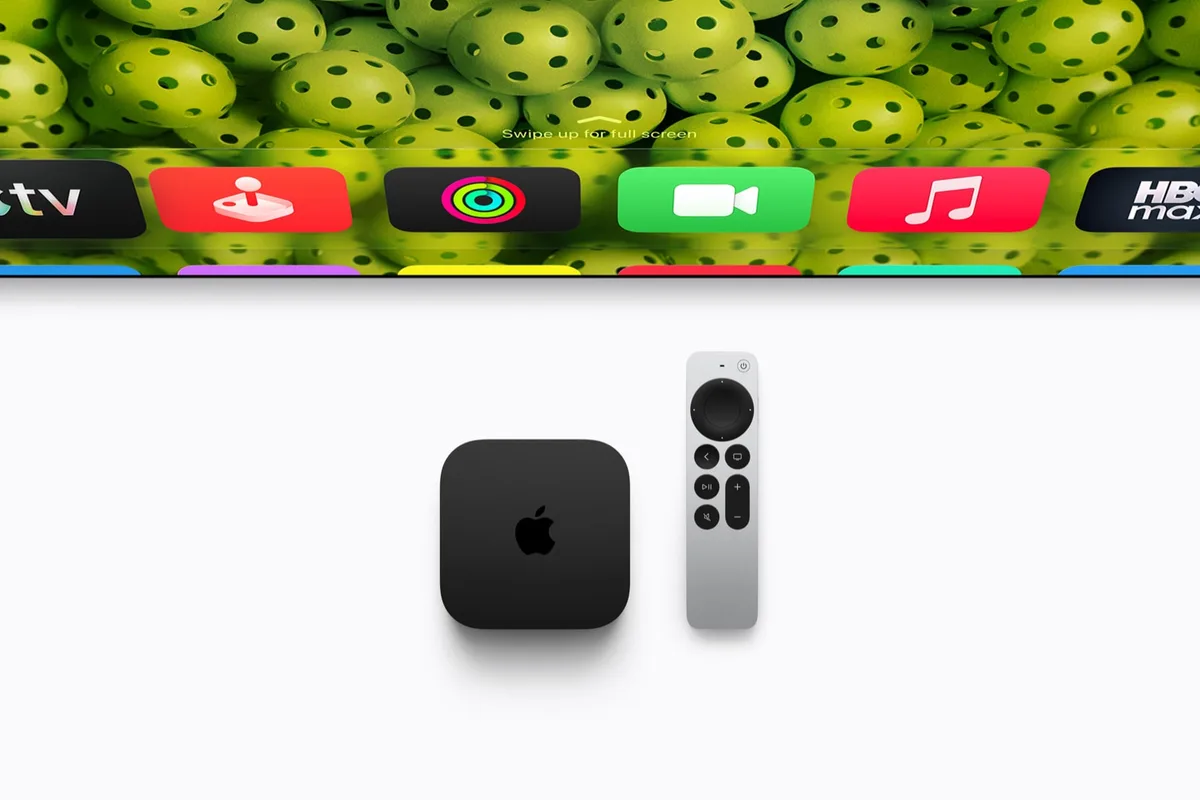
The four-HomePod system requires the fourth-generation Apple TV 4K, announced on October 13 and scheduled for release on November 13.
Even when tvOS 27.2 can be installed on an older Apple TV, that device does not automatically gain four-speaker surround support.
Four physical speakers around the viewer
Until now, Apple's HomePod home theater offering has mainly relied on one or two speakers located near the television.
The new system introduces two front speakers and two rear speakers.
That difference matters for movie and television soundtracks.
Surround sound can direct selected audio elements toward speakers behind the viewer, making the scene feel as though it extends beyond the screen.
A vehicle moving across a scene, environmental sounds in a forest or effects coming from behind the audience may benefit from more clearly separated physical sources.
The experience will depend on the content and the system's processing.
Apple presents the new arrangement as an improvement in immersion compared with its previous HomePod configurations.
However, the acoustic performance has not yet been independently evaluated on commercially available hardware.
Which HomePod models are compatible?
Apple's compatibility requirements are relatively strict.
Four-speaker surround requires second-generation HomePods or HomePod mini 2 speakers.
The original full-size HomePod and first-generation HomePod mini are excluded.
Compatible speakers must also be arranged in matching pairs.
Users can install four second-generation HomePods.
They can choose four HomePod mini 2 speakers.
They can also combine the two families, using a pair of full-size HomePods at the front and a pair of HomePod mini 2 units at the rear.
The opposite arrangement is also possible.
The essential requirement is that each front or rear pair uses the same speaker model.
Apple does not announce support for combining four arbitrary HomePod models in any arrangement.
Matching speakers within each pair provides more consistent acoustic characteristics for the system to manage.
Previous Apple TV 4K models remain limited to two HomePods
The required Apple TV hardware is probably the most important limitation for existing customers.
First-, second- and third-generation Apple TV 4K models do not support the new four-speaker system.
They retain their existing HomePod audio features, including stereo output through compatible speaker pairs.
Selected existing arrangements can already reproduce Dolby Atmos or multichannel soundtracks through audio processing.
However, that is not equivalent to the new configuration with four physical speakers positioned around the listener.
Installing tvOS 27.2 does not remove the hardware compatibility requirement.
Anyone hoping to expand an existing HomePod installation to four-speaker surround will therefore need the fourth-generation Apple TV 4K.
Automatic calibration adjusts to speaker placement
Apple is doing more than simply allowing four audio devices to connect.
The company also promises automatic room-aware calibration.
The new Apple TV 4K and compatible HomePods are designed to recognize where the speakers are positioned.
The system then adjusts audio timing and levels to account for their arrangement.
These parameters matter when trying to create a coherent sound field.
When multiple speakers reproduce the same sound event, the distance between each speaker and the listener can affect when the signal is heard.
Timing adjustments help compensate for those differences and support a more continuous acoustic presentation.
Apple's announced calibration could simplify work that traditionally requires more technical setup with an AV receiver.
However, independent measurements have not yet established how accurately it performs in rooms with different layouts.
Walls, reflective surfaces and furniture can significantly affect the result.
Surround Sound and Whole Room Audio serve different purposes
Apple is also preparing a feature called Whole Room Audio.
Its objective differs from cinema-focused surround sound.
A home theater setup generally prioritizes a listening position facing the screen.
Whole Room Audio instead aims to distribute sound more evenly throughout the space.
That can be useful when people move around a living room while music is playing.
Parties, gatherings and live sporting events do not necessarily involve everyone sitting in the same position.
Apple describes the mode as a way to provide more consistent audio across the room.
It is not an additional multichannel audio format.
It is a playback mode intended for a different listening scenario.
Software beta analysis has also revealed controls related to stereo spatialization and rear-speaker levels.
Their final behavior will need to be confirmed using commercial hardware and software.
Simpler than a conventional home theater system?
The main attraction of Apple's approach is integration.
Four HomePods can communicate without the same arrangement of speaker cables required by passive speakers connected to an AV receiver.
The Apple TV manages pairing and audio processing.
That may appeal to users who do not want to route audio wiring between the front and rear of their living rooms.
However, wireless audio does not mean every cable disappears.
HomePods still require electrical power.
Suitable outlets are therefore needed near their intended locations.
The system removes some audio cabling, not every placement constraint.
It also remains closely tied to Apple's hardware ecosystem.
The announced four-speaker surround configuration does not extend to arbitrary AirPlay speakers from other manufacturers.
Four HomePods are not automatically equivalent to a 7.1.4 system
Speaker count is only one part of home theater design.
A traditional multichannel system may include front speakers, a dedicated center channel, surround speakers, a separate subwoofer and height speakers.
A 7.1.4 configuration therefore uses a more extensive physical speaker layout than four devices surrounding the viewer.
HomePods rely on digital processing to adapt their output and create an immersive sound field.
That processing may produce convincing spatial effects, but it does not physically turn four speakers into an installation with the same number of dedicated channels and components.
It would be misleading to describe Apple's system as materially identical to a complete 7.1.4 setup.
Conversely, it would be premature to dismiss its potential sound quality.
Performance will depend on calibration, source content, room acoustics and the capabilities of the chosen HomePods.
Independent testing will be necessary to compare it meaningfully with premium soundbars and conventional multichannel systems.
Can HomePod mini 2 work effectively as a rear speaker?
One of the most interesting possibilities is using HomePod mini 2 units for the rear channels.
Their compact dimensions may make them easier to position on shelves or furniture.
Users could place two second-generation full-size HomePods near the television and two mini 2 speakers behind the listening area.
That arrangement reserves the larger speakers for the front of the room.
However, its acoustic balance will need to be evaluated.
The two speaker families have different physical designs and acoustic capabilities.
Their bass performance, output limits and overall presentation may therefore differ.
Automatic calibration is intended to help integrate them, but cannot remove every physical difference between speaker types.
Apple confirms the mixed configurations are supported, though their real-world performance remains to be measured.
HomePod 27.2 also introduces Sound Glow
HomePod Software 27.2 includes more than preparation for surround audio.
It also introduces Sound Glow, a synchronized lighting feature.
The top surface of compatible HomePods can display colored lighting effects while music plays.
The system can use colors associated with album artwork to create visual effects.
Sound Glow is supported on the second-generation HomePod, the original HomePod mini and HomePod mini 2.
It is not available on the original full-size HomePod.
These compatibility requirements differ from those of four-speaker surround.
An original HomePod mini can therefore gain Sound Glow without becoming compatible with the new four-speaker home theater configuration.
This illustrates how the same software update can offer different capabilities depending on hardware generation.
Compatible HomePods can also serve as Mac speakers
The 27.2 update also expands HomePod's role beyond the living room.
Apple adds support for using selected HomePods as the default audio output of compatible Macs.
This could allow the same speakers to be used for video calls, music and multimedia playback.
However, compatibility depends on the Mac model and Apple's software requirements.
It should not be confused with simply sending audio temporarily over AirPlay.
The update also introduces Lock Controls, an option that restricts touch interactions on the top of the speaker.
This could be useful in homes where accidental touches regularly interrupt playback or activate controls.
Together, these changes make HomePod 27.2 relevant even to users who are not planning to purchase a new Apple TV 4K.
How much will the new home theater setup cost?
Cost is an important limitation of Apple's approach.
The fourth-generation Apple TV 4K has a French starting price of €349.
Four compatible HomePods are also required unless the user already owns some of them.
The final price depends on the combination of full-size HomePod 2 and HomePod mini 2 speakers.
An installation consisting entirely of full-size speakers will differ financially and acoustically from one using four mini models.
Someone who already owns two second-generation HomePods might be able to expand gradually by adding a compatible rear pair.
However, replacing an older Apple TV is still an additional expense.
The total should therefore be compared with similarly priced soundbars and conventional home theater equipment.
Price alone is not the only consideration: available space, intended use and setup simplicity also matter.
A staggered launch continuing through November 13
The release schedule explains why the new feature may appear to be available before consumers can actually use it.
Apple announced the new Apple TV 4K and HomePod mini 2 on October 13.
The tvOS 27.2 and HomePod 27.2 software updates arrived on October 26.
HomePod mini 2 is scheduled to reach stores on October 30.
The new Apple TV 4K, required for the surround configuration, is scheduled for November 13.
The software is therefore arriving before all necessary hardware becomes commercially available.
Users should not assume that installing tvOS 27.2 alone makes the four-speaker configuration operational.
This distinction also prevents experimental behavior observed in beta versions from being confused with the final retail experience.
Apple is expanding home theater audio while tightening ecosystem requirements
Four-HomePod surround sound is a logical extension of Apple's living-room strategy.
The company aims to make home audio more immersive without requiring the complexity of a conventional multichannel installation.
Automatic calibration and wireless audio connections could be meaningful practical benefits.
However, the system remains relatively closed.
It requires a specific Apple TV generation and two supported HomePod families.
Owners of older hardware must either retain their current configurations or invest in a new streaming box and potentially additional speakers.
The announced acoustic benefits still need independent testing.
tvOS 27.2 is therefore an important software milestone, but the real consumer launch of Apple's four-speaker surround experience will wait for the fourth-generation Apple TV 4K on November 13, 2026.