 By Adri
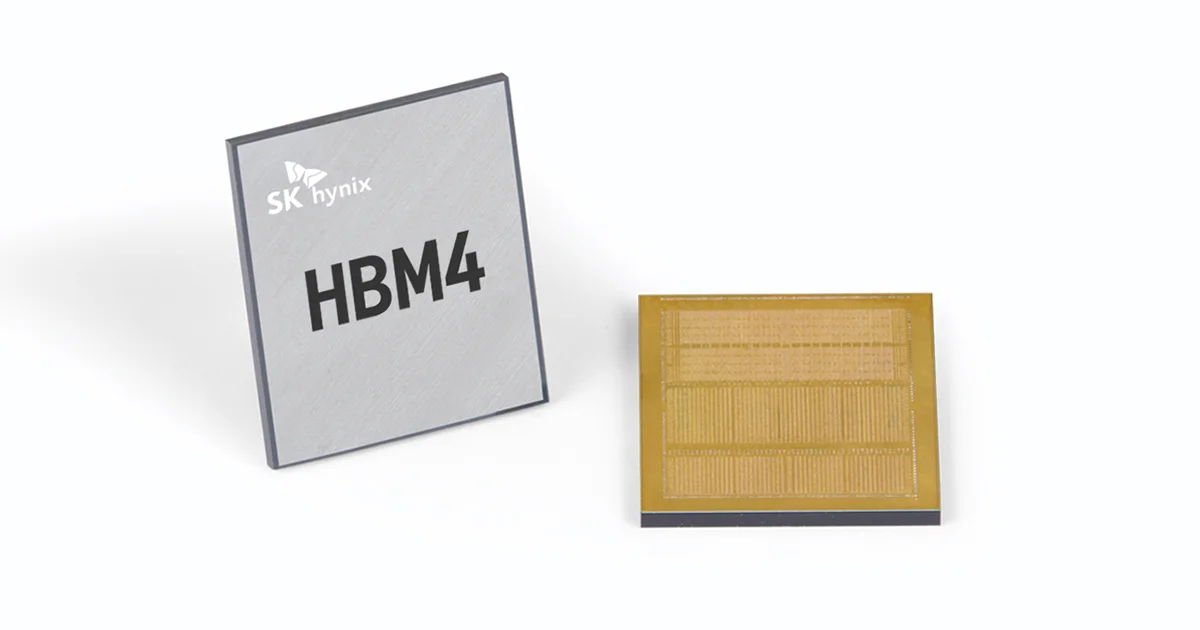
AI accelerators attract most of the attention in data center hardware, but their performance depends heavily on memory. A powerful processor can spend valuable time waiting when its memory subsystem cannot deliver data quickly enough.
SK hynix has become one of the major beneficiaries of that constraint. The South Korean manufacturer reported another record quarter, supported by rising demand for high-bandwidth memory, server DRAM and enterprise storage.
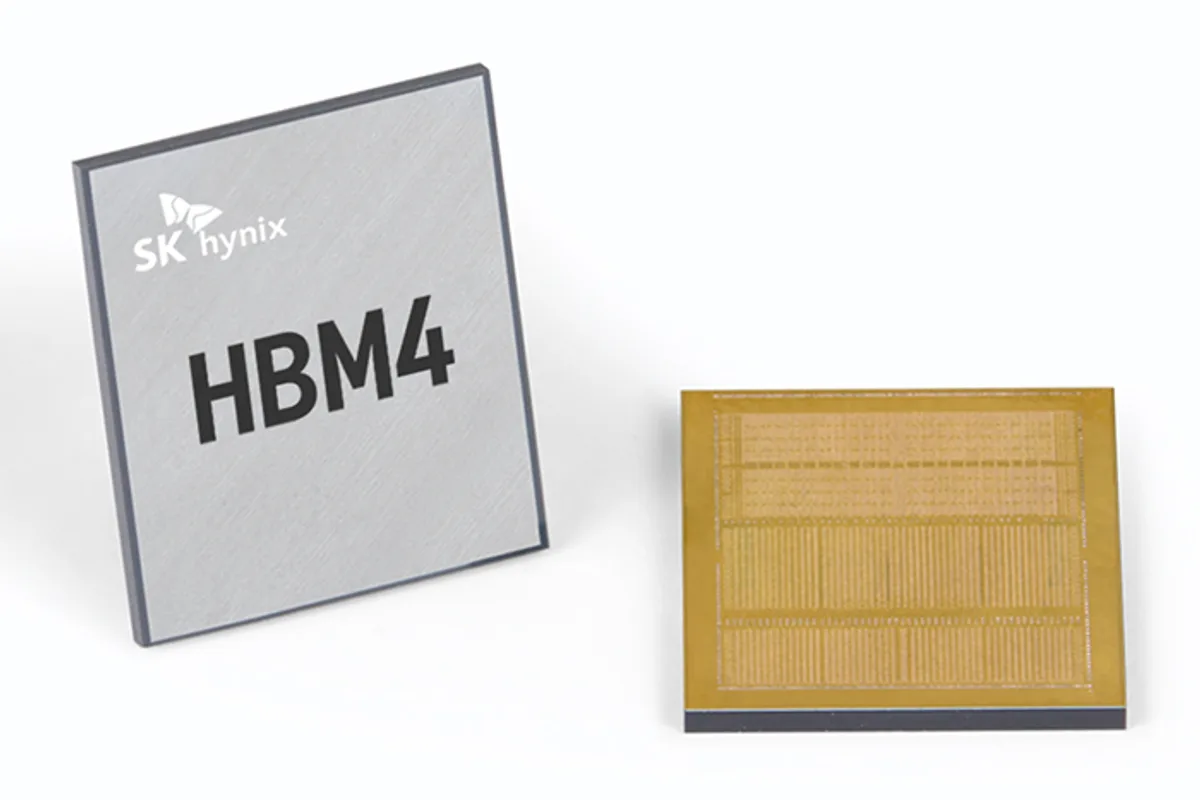
The company has also revealed an important near-term shift in its product mix. HBM4, the latest generation of high-bandwidth memory, is expected to overtake HBM3E by both shipments and revenue during the final quarter of 2026.
Quarterly revenue exceeds KRW 100 trillion for the first time
SK hynix reported third-quarter revenue of KRW 104.6155 trillion, compared with KRW 79.3187 trillion in the second quarter and KRW 24.4489 trillion one year earlier.
That represents growth of approximately 32% quarter over quarter and 328% year over year.
Operating profit reached KRW 83.3338 trillion, up 38% sequentially. The company's reported operating margin increased from 76% to approximately 80%.
Those numbers indicate exceptionally strong pricing and demand conditions, alongside a shift toward more profitable memory products.
Net income reached KRW 39.7756 trillion. It increased substantially year over year but declined by 58% compared with the previous quarter.
The distinction between operating profit and net income is important because the two measures are affected by different financial items.
SK hynix also states that its third-quarter financial results are preliminary and remain subject to the final independent audit process.
HBM4 is moving into the mainstream of AI infrastructure
High Bandwidth Memory uses vertically stacked memory dies placed close to the processors that consume their data.
The architecture provides substantial bandwidth within a compact physical footprint, making it particularly useful for large AI accelerators.
HBM4 expands the memory interface to 2,048 bits, compared with the 1,024-bit interface used by the preceding HBM3E generation.
Higher bandwidth can improve the rate at which data reaches GPU computing units, reducing some of the bottlenecks that arise in large-scale model training and inference.
SK hynix says HBM4 shipments increased significantly during the third quarter as production and deliveries accelerated.
The company now expects HBM4 to surpass HBM3E in shipment volume and revenue during the fourth quarter.
That is a forecast concerning its future sales mix. It does not mean every customer has already completed a transition to the new technology.
The M15X facility is central to the production ramp
SK hynix plans to bring its M15X facility toward maximum operating capacity by the end of 2026 to increase HBM4 output.
Advanced HBM manufacturing requires more than producing conventional DRAM dies. The stacking process, packaging, thermal requirements and qualification procedures introduce additional manufacturing challenges.
Production capacity therefore cannot always be expanded as quickly as demand increases.
A supplier must also complete customer qualification procedures before newly manufactured components can be incorporated into the relevant accelerators and systems.
SK hynix expects memory supply constraints to persist through 2030, reflecting the long lead times associated with new factories and the technical difficulty of advanced manufacturing.
That is the company's market outlook rather than a guaranteed prediction of future shortages or prices.
More than half of planned 2027–2028 capacity is under long-term agreements
SK hynix has signed long-term supply agreements with 14 major customers, including leading cloud service providers.
The company says those agreements cover more than 50% of its planned total production capacity for 2027 and 2028.
Such commitments provide visibility into future demand and can reduce some of the uncertainty associated with the semiconductor industry's traditional purchasing cycles.
The agreements include pricing mechanisms that allow changes within ranges negotiated between the company and its customers.
Consequently, they should not be understood as fixing all selling prices permanently for multiple years.
SK hynix has not disclosed a complete customer-by-customer allocation of the contracted volume or the exact proportion attributable specifically to HBM4.
The greater-than-50% figure refers to planned total production capacity. It should not be misinterpreted as a claim that the same percentage of every product category has been sold under identical conditions.
AI memory demand extends beyond GPUs
HBM is one part of the infrastructure required for modern AI systems. Server CPUs, data-processing services and applications surrounding the models depend on other forms of memory.
SK hynix reports growing sales of server DDR5 alongside its HBM4 expansion.
The emergence of AI agents reinforces the need for diverse infrastructure. Such systems can execute programs, retrieve information, coordinate tools and perform numerous operations outside the model's core inference workload.
These activities rely on CPUs, system DRAM, networking and storage.
SK hynix intends to expand DDR5 and LPDDR5 SOCAMM sales for AI servers while increasing adoption of its sixth-generation 10nm-class DRAM manufacturing technology, known as 1c.
The company is therefore positioning its memory portfolio around the complete data center system rather than a single category of accelerator.
Enterprise SSDs are another area of growth
SK hynix also reports stronger sales of enterprise SSDs based on 321-layer TLC NAND.
AI infrastructure requires substantial storage for training data, model checkpoints, intermediate results and application content.
The company plans to increase the proportion of 321-layer NAND to more than half of its domestic production capacity during the fourth quarter.
Looking further ahead, SK hynix is exploring High Bandwidth Flash, or HBF, as a technology that could improve throughput and cost efficiency in future AI systems.
HBF and HBM serve different performance and capacity requirements. The announcement does not establish that HBF is generally available as a replacement for HBM.
The company expects shortages to continue through 2030
SK hynix believes AI infrastructure investment is creating a sustained imbalance between memory demand and available supply.
The company points to the technical complexity of advanced processes and the time required to establish new manufacturing capacity.
Even after a new facility is approved and funded, construction, equipment installation, qualification and production ramp-up can take years.
The manufacturer expects those constraints to remain relevant through 2030.
The outlook could support memory manufacturers' pricing power, but higher component prices may also increase costs for data center operators and other hardware producers.
Different memory products should not be treated as interchangeable, however. A shortage of advanced HBM for AI accelerators does not automatically imply an identical shortage or price increase for standard consumer DDR5 modules.
Market conditions must be assessed by product category and supply chain.
Capital investment will increase in 2027
SK hynix plans a significant expansion of capital expenditure in 2027.
The company expects the first phase of its Yongin industrial complex to enter full-scale operation, alongside continued investment in domestic and overseas infrastructure.
Management says the scale and timing of investment will remain flexible, taking customer demand, profitability and capital efficiency into account.
The company's reported financial position gives it considerable flexibility.
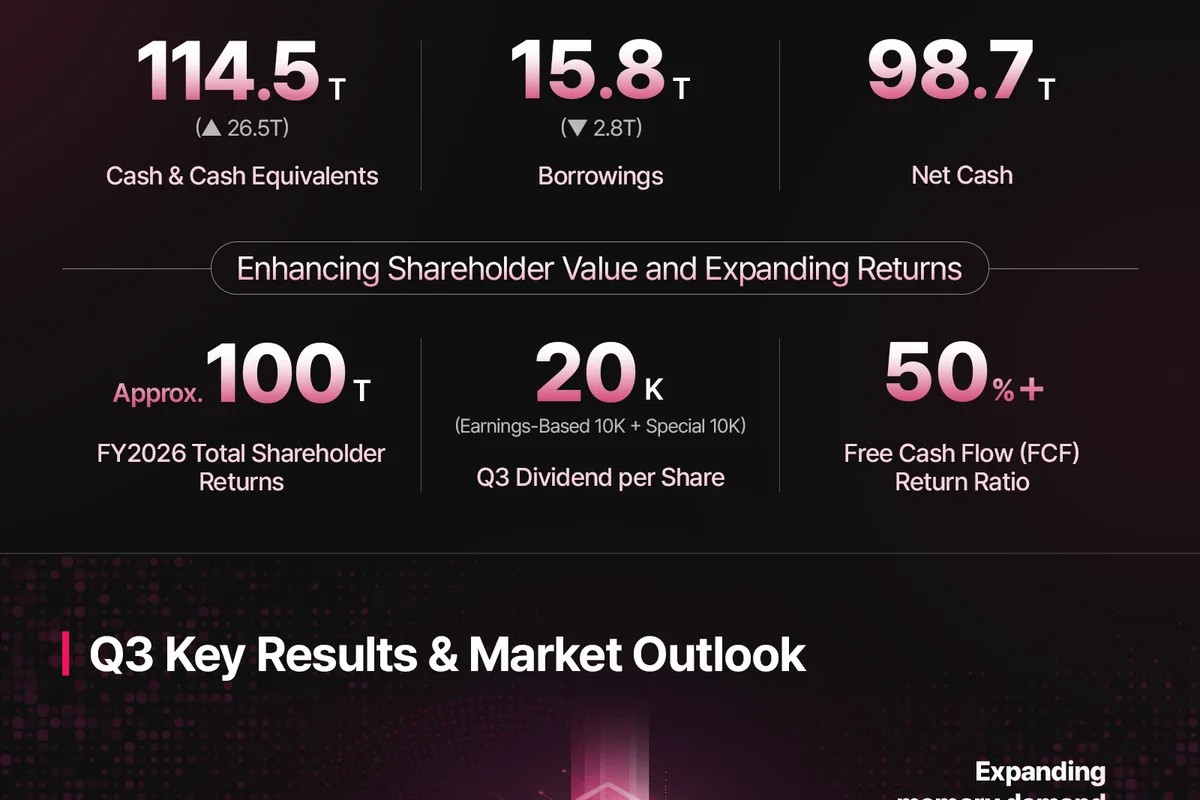
At the end of the third quarter, SK hynix held KRW 114.5 trillion in cash and cash equivalents, while borrowings stood at KRW 15.8 trillion.
That produces reported net cash of KRW 98.7 trillion.
A strong balance sheet can support capacity expansion, although it does not guarantee that new factories will achieve their expected returns.
Shareholder returns are also reaching exceptional levels
SK hynix is planning approximately KRW 100 trillion in shareholder returns for 2026.
The program includes at least KRW 30 trillion in cash dividends and more than KRW 60 trillion in share repurchases and cancellations.
Previously announced repurchases are included in those totals. The company says it completed a KRW 40 trillion buyback during the preceding week.
It also intends to distribute a substantial portion of the investment gains realized from Kioxia through special dividends.
These shareholder distributions are separate from the company's planned manufacturing investments.
The announced figures describe the company's 2026 capital allocation program and should not be interpreted as a commitment to repeat the same level of returns every year.
The sustainability of HBM4 profitability is the next test
SK hynix's latest results demonstrate the extraordinary economics currently associated with advanced memory for AI infrastructure.
The transition from HBM3E to HBM4 is already underway, with the newer technology expected to become the company's leading HBM product before the year ends.
Long-term agreements improve demand visibility, while supply constraints are supporting favorable selling conditions.
However, important uncertainties remain. The company must maintain manufacturing yields, expand capacity economically and respond to changing customer requirements.
The pace of AI infrastructure investment is another variable. Strong current demand does not establish that every future project will be completed at the originally anticipated scale.
An operating margin close to 80% is an exceptional quarterly result, not a guarantee of permanently elevated profitability.
For the broader technology industry, the structural lesson is clear: the next generation of AI systems will be defined not only by faster processors, but also by access to high-performance memory and the manufacturing capacity needed to supply it.